It’s basically a virtual DJ mixer right in your browser. There’s no installation or download required. It’s a two-deck controller. All of the audio are electronically made by the system. Control it using your computer keyboard, touchscreen or mouse. Listening to it via headphones is best.
There is no sound button. The sound switch on the first time you start a deck, whether it’s Deck A or Deck B. When it’s time to begin a deck, the status line at the bottom tell you so. Click the start command once and sound will start.
How to Use the Online DJ Mixer
To get to sound credits and a guide, click the question mark icon up top. The Full screen button gives the mixer your whole screen. Click Exit full screen or press Esc and you’re back to regular view of the page.
Overall volume is controlled via the Volume slider in the bottom bar. Two channel names appear on the mixer: DECK A and DECK B. On DECK A is a loop called Pocket groove. It’s a bass line with drums. On DECK B is Neon chords. This has chords, melody and a light beat.
The level meter indicates volume levels. The time counter show the elapsed time of each track. The moving playhead shows where you are at any given moment, and the waveform show what the music looks like.
To begin playing a deck, you push ▶ Play. The button turns into Ⅱ Pause. If you want to jump back to the beginning of the track, you can do so by pressing ↶ Cue.
At the bottom is the crossfader, marked A and B, which balance the two decks. Placed in the middle, it will play both decks together. Moving it to one side raises the level of that deck and fades down the other. A Level slider on each deck provide independent volume control.
The Low and High EQ sliders control frequency range, 12 (high) to… -24 (low). Turning the Low slider down tames the bass; turning down the High slider softens high frequencys. Raise them back up as you blend songs.
The BPM slider runs from 80 to 150 and starts at 120. The BPM slider adjusts speed from 80 to 150 with a default setting of 120. Like on a real-world turntable, changing the tempo changes both pitch and speed. So you’ll not only get a faster mix but one that sounds higher in pitch than too.
The Sync ↔ button. This keeps the two loops in time by restarting each from the same downbeat.
On each deck there’s a menu called The Loop which let you choose either 4 beats, 2 beats, 1 beat or Full. If you choose a shorter one then it will repeat that section of music from where you are playing on the track. It is great for building up tension before the drop. If you choose Full, it will revert back to normal play.
There are eight numbered hot cue buttons which denote equally spaced sections of the track. These can be tapped in time when the loop is playing and this allows you to remix it as it goes.
Clicking Load on one of the decks allows you to load your own audio files. It doesn’t upload them but rather just opens the file right there in the browser. The name of that file appear where the previous track’s name was. An error message is displayed in the status line if the system can’t open a file.
The keyboard works like this: On a computer, press the A key to begin one loop (deck A). Press the B key to start the other (deck B). To synchronize the two loops, hit the Space bar. Use the left and right arrow keys to move the crossfader bit by bit. Be sure you have clicked within the mixer frame first.
To play both loops simultaneously, starting from the beginning, press ▶ Demo mix. Both loops will play, with the crossfader sweeping automatically back and forth across the decks. Click ■ or press the button again to stop everything.
There is also a series of lessons called ◇ Learn to mix. It’s a six-step guide that teaches you the basics. The steps are Start deck A, Start deck B, Blend to B, Cut B bass, Sync decks, and Blend to A. This guide emphasizes what controls to use for each step. Once you have mastered the previous step, the system move to the next. When you’ve finished, it displays Mixing lesson complete on the status line.
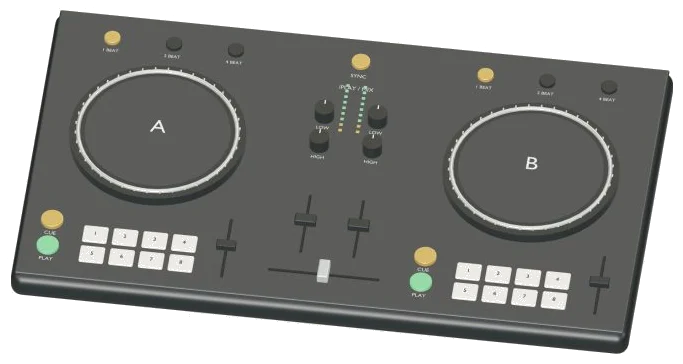
This also applies to the 3D controller model which is completely interactive. You can use its knobs, faders, buttons and jog wheels just as you would the ones on screen. The pads become hot cues; the knobs turn deep cuts on/off. When a deck is playing, the jog wheels spin and let you jump ahead a little. And when you mix, so do the faders on the 3D model.
Click on 3D · Rotate to explore the controller. Use two fingers to zoom (on touchscreen). Scroll to zoom in/out, drag to rotate view around. Controls still work as you spin the model round. Tap ↺ to reset view. Switching Rotate off also resets the view. Switching Rotate off will also reset the view.
First if you’re a novice DJ, play Deck A first and then Deck B. Then slide the crossfader gradually over from A to B. Next try this Learn to mix guide. Cut the bass on one deck as you bring in the other.
You should of tried this moddern mixer. It’s actualy very luxurius.