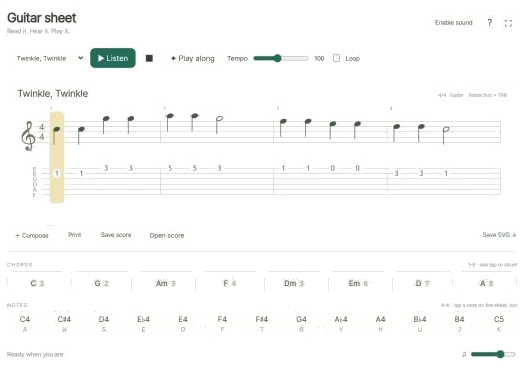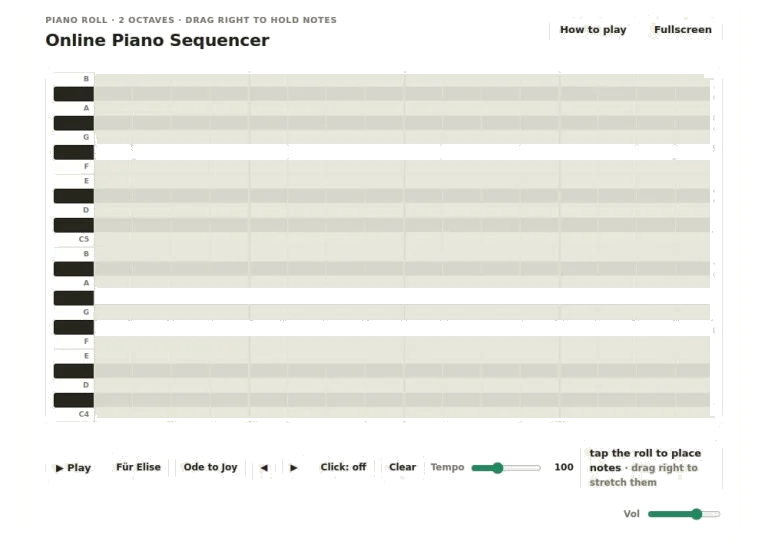
Compose songs using an online piano sequencer that enables you to arrange notes on a grid and then play them back. There is two main ways to use this widget. First, you can tap or click on the grid cells to place notes. Second, the transport controls allows you to begin playback.
Essentially it’s like a stripped down digital audio workstation. Instead of the traditional sheet music we’re used to seeing, the tool enable us to visualize music as a series of horizontal bars. It’s intuitive enough that you can dive right into the action without complicated set up.
How to Use the Online Piano Sequencer
A piano roll grid is the central part of the widget. Each row represent a pitch, and the left-hand sidebar has labels showing those pitches. There are two octaves in the range: C4 (bottom) through to B5 (top). Certain rows has been coloured differently. These colour-coded rows indicates the black notes on an actual piano. That way, you can see where you are quite easily just by looking.
The columns indicates time, which is divided into sixteen sixteenth-note steps. This means that the grid will play back in a continuous loop. It goes from the first step to the sixteenth and then back to the start again. Because of this looping pattern, you can create repetitive rhythmic patterns that flow easy.
By default, if there is an empty cell in the grid, then that is where you click to add a note. It will show up as a green bar indicating how long it lasts and where it sits on the grid. You can stretch out any note by clicking and dragging to the right. This will extend the green bar which means the note will last for longer when played back. To delete a note, simply click on the first cell of the green bar again and it will go. The grid will update automaticly. Additionally, you can use this to put multiple notes into the same column, creating chords. Then you can play these harmonies without having to worry about complicated fingerings.
At the bottom are transport controls that control time and playback. Pressing the Play button begins playing the loop, and pressing it again stops the audio. As the music plays, you will see a sweep of the playhead line through the grid. That indicates precisely what step is playing at any given moment.
The BPM slider adjust the tempo. If you move the slider to the left, the loop becomes slower. If you move the slider to the right, the loop becomes faster. This is great if you want to practice something slowly or give your melody a faster feel.
The volume slider controls the master output level making sure the sound coming out of your speakers and in your ears is comfortabley.
There are some help buttons that will help in your composition. The first is a Click toggle for turning on a metronome. This lets you hear a tick sound as it hits each beat so that you know where you are and remain in time as you add notes.
There are Shift buttons for moving all notes you have added a step to the left or right respectively. That’s useful if you’d like to tweak the timing of a phrase but don’t want to redraw all the notes.
Then there are some pre-loaded examples such as Ode to Joy or Fur Elise that shows what those classic tunes would of sounded like on the grid. Finally, there’s a Clear button that erases everything and gives you a blank slate to start again.
There are keyboard shortcuts that let you interact with the widget more quickly. The spacebar toggles playback, letting you start or stop the loop without using the mouse. The question mark toggles the help panel, which is a quick reference to how everything works.
Click the fullscreen button to maximize the widget for a bigger view of the piano roll. More on-screen space makes it easier to read and place notes with higher accuracy.
To get the best from this instrument experiment with space and rhythm. Leaving gaps between your melody allow the notes to breathe. Rests can be interesting and cause tension too if used well. Try adding layers of rhythms across adjacent octaves to make a more full sound. How the notes are long and short affects the flow which you see visually on the grid. Shorter notes bring movement, while longer ones gives it stability. Use the tempo slider to adjust the speed of what you want to achieve.
The grid is a flexible canvas, ranging from simple tunes to complex patterns. Hit play and add a couple of notes. Hear what it sounds like and change them if you want, or move them around. Because you get such immediate feedback, you can change things fast. There are no rules for using the sequencer. Go ahead and make mistakes and explore. It’s meant to be responsive and forgiving.
Dive right in and begin arranging your next melody today.