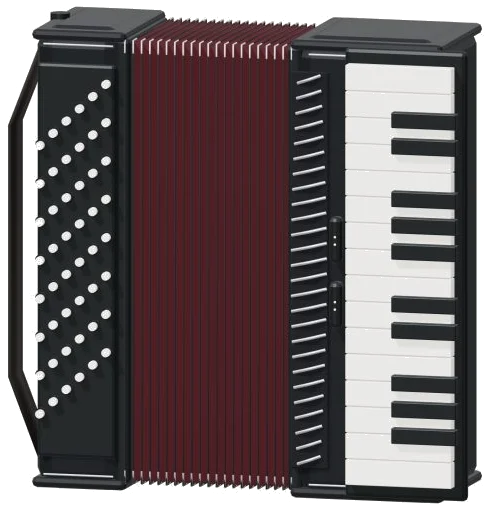
Play a piano accordion directly in your browser with this online virtual accordion. There’s no installation or downloading required; just go to the site and play.
It feature a detailed 3D model of an accordion with 26 piano keys and 48 bass buttons, uses real recordings of a Hohner accordion for each note, and what you’re hearing is indeed a genuine reed sound, not coming from a synthesizer. You can play it with your computer keyboard, with your fingers on a tablet or phone, or even with a mouse. The sound turns on when you play your first note. When it’s done loading, the widget will show “Recorded instrument sound” at the bottom, and that’s it, there’s no start button to find. Clicking the question mark in the top corner reveal the credits for the recordings as well as a brief guide to the controls.
How to Use the Online Accordion
You can adjust all the sound options from directly beneath the instrument, which means you don’t need to stop playing to do so. You can begin playing straight away by pressing a key on the keyboard below or on the 3D accordion itself. Tap the key for a short note or hold it down. You can also see the bellows in the centre that open and close as the accordion plays. You can drag your finger along the keys for a sequence of notes. If you press some of the bass buttons on the left hand side of the model they will play too. They are the bass notes but some only produce one low bass note while others sound a complete three-note chord. This means you could play a left-hand accompaniment to your melody.
The 26 piano keys is played from B3 at the bottom up to C6 at the top on a computer keyboard using the letters: A W S E D F T G Y H U J K O L P; Z X C V B N M,. These play one semitone higher each time with every key showing the letter that plays it on the screen. You don’t need to learn where anything is as they are all there. The accordion is placed within its frame on the page too; just click into it and then begin playing from the keyboard.
There’s also a row of chord buttons below the keyboard (C, Dm, Em, F, G and Am). These are matched by the numbers on the keyboard 1 to 6 so that you can easily create a simple accompaniment with one hand. A good starting point would be to step up and down from C, then F then G. Add in Am and you have a selection of chords that will cover a huge amount of simple songs.
Under the word PLAYING is the note or chord you just played and this is displayed in the bar under the accordion. Pressing the Play button (or the Space bar) will play that chosen note or chord while it’s held down. Keep bellows (next to it), continues playing the existing note or chord without further action by you. As long as keep bellows is engaged, then a single click on any other chord or key will override the previous one, allowing you to switch notes with a single click rather than having to hold them all down. Pressing the Esc key stops all sound instantly.
Running from 10 to 100 and starting at 65, the Bellows slider is called that because it’s like pushing the bellows in or out gently or harder. So it makes the accordion sound louder at higher levels and can even change the notes you’re already playing. Three sound presets go further down. Natural is just the plain recorded tone. Musette adds another layer of slightly detuned copies of all the notes. These sit above the first layer with a sort of shimmering sound. Soft has a darker, gentler tone. Each preset also sets the Room slider which adds an echo of a room around the instrument. This runs from 0 to 50. At the bottom right is the Volume slider which sets the overall level.
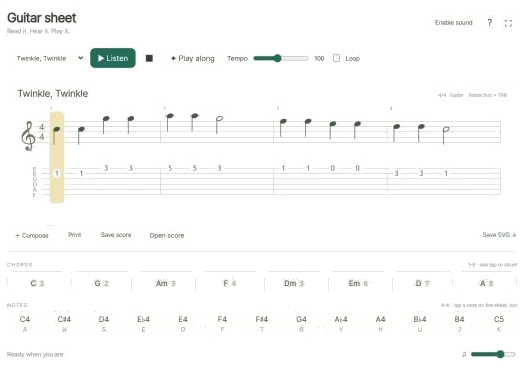
In the PLAY A LITTLE menu, select one of the tunes: Little lanterns, Twinkle, Twinkle, or Ode to Joy. Click ▶ Listen, and the accordion plays it back to you. Adjust the Tempo slider (from 40, 180) to speed it up or slow it down. Once you know it, click ◇ Game mode. You’ll see a small panel that says Tap the green note… and shows what’s coming in the play now, NEXT and THEN boxes. The next note to play will glow green on the keyboard and on the 3D model. As soon as you’ve played the right note, game mode waits for you and then carries on. There’s also a progress bar and counter to show how far along in the tune you’re getting. When it’s done it asks Beautiful. Play it again? It also has an Again button to let you have another go.
To record your playing directly from the instrument without needing a microphone, click the ● Record button. When it says ■ Finish take, click it again. There will be a link to save the take, which lets you download the recording.
To explore the virtual accordion online from all angles, click ↻ Rotate 3D. You can turn it by dragging the background, zoom in/out with a pinch, and zoom in/out using your mouse wheel. While it’s rotating you’re still able to press the buttons and play the keys on whatever side you choose. To return to the front view hit the ⌂ button or toggle off the option for Rotate 3D.
According to the credits on the guide, the sound is derived from a recording of a Hohner accordion (by Jeff Stauffer), processed by FreePats (michael02022) via Piotr Barz. It’s available as a CC0 licensed sound recording.
If you are not used to playing the online virtual accordion, begin by selecting the Natural preset and then playing some notes from the home row of your keyboard. Add in the C, F and G chords using the number keys and see how you get on. Use Game mode to play Twinkle, Twinkle slowly until you are comfortabley with the melody.